
Transport communications

Portcare International is the press relations consultancy for the shipping and logistics industry. Formed by transport people for transport people. We can truly claim to understand our clients’ needs and ‘talk the same language’. Portcare provide effective, value for money PR to some of the industry’s best-known names.

Call for Packing Code’s Adoption and Enforcement

25th September, 2017

A coalition of leading cargo industry organisations representing the full breadth of the global supply chain is maintaining its campaign for safer practices in packing freight containers and other cargo transport units (CTUs). During a meeting held at the IMO during London International Shipping Week, the group asked delegates of IMO member states for the backing of their governments to communicate the content, to encourage and oversee the use of the IMO/ILO/UNECE[1] Code of Practice for Packing of Cargo Transport Units (CTU Code) within their jurisdictions.

The four industry bodies, Global Shippers Forum (GSF), ICHCA International, TT Club and World Shipping Council (WSC) participated in the experts group that created the comprehensive guidance for safe and secure packing of CTUs and was thereafter adopted by each of the UN agencies during 2014. As such, the key stakeholders in the intermodal supply chain together with the leading freight industry insurer continue to drive forward the implementation of this important work.

Speaking on behalf of shippers, Chris Welsh, the Secretary General of GSF said, “Our coalition epitomises the depth of industry cooperation that exists in ensuring the safety of operatives across the supply chain and the security of cargo; now there is clearly a greater need for action by national governments to support these industry initiatives. In fact it is critical that governments play a role in effecting the more widespread use of the Code among those loading CTUs on a daily basis.”

TT Club’s Risk Management Director, Peregrine Storrs-Fox pointed out the importance of this awareness and enforcement of the Code, “The maritime freight container, in particular, has diversified the responsibility for safe cargo packing away from the historic concentration of expertise at quaysides and docks. Those packing containers at factories, warehouses and depots situated remotely from the port, or indeed from a railhead or other intermodal hub, are generally unaware of the consequences of a poorly packed steel coil and unsecured drum of hazardous chemicals. As a specialist insurer, TT Club continually sees the sad repercussions of truck rollovers and train derailments, cargo spillages, and explosions and fires at ports or on-board ships.”

Credible statistics are hard to come by, partly due to a lack of engagement by state authorities with IMO’s container inspection standard, but ICHCA International’s Richard Brough made an attempt to estimate the extent of the problem based on UNCTAD trade statistics and the results of the relatively few inspections made during the last fifteen years. “Extrapolating from the UNCTAD figure of 180 million TEUs traded, via the 24% of inspected containers carrying dangerous goods (DG) that were found to be badly packed and bearing in mind that cargoes declared as DG make up only around 10% of all containers, we can estimate that each year some 25.9 million containers are potentially poorly packed and pose a danger at some point on their journey along the supply chain.”

Lars Kjaer, Senior Vice President of WSC drew attention to the vital matter of container pest contamination explaining, “Carriers should ensure that empty containers to be delivered for packing are clean and pest free. However, the International Plant Protection Convention (IPPC) has confirmed that pest contamination of containers and their cargoes is most likely to occur at the point of packing. Shippers and packers need to take appropriate steps to prevent pest contamination of containers while in their custody.”

All four organisations are in no doubt about the extent of the task in hand to extend the best practices enshrined in the CTU Code to the majority of those involved in packing containers around the world. A lack of training, language problems, the sheer density of the information contained in the Code, dramatic variations in the types of cargo now being carried in containers and the complexities of international supply chains are among the myriad of challenges facing the industry in achieving widespread adoption. However, this coalition of industry bodies is determined to advance towards their goal and emphasise once more the crucial role that IMO member states should play in supporting their efforts.

For reference the full CTU Code can be found here http://www.imo.org/en/OurWork/Safety/Cargoes/CargoSecuring/Pages/CTU-Code.aspx


ENDS

Notes for Editors

The Global Shippers’ Forum (GSF) is the world’s leading global trade association representing shippers engaged in international trade moving goods by all modes of transport. Chris Welsh MBE chaired the Expert Working Group charged with drafting IMO/ILO/UNECE Code of Practice for Packing of Cargo Transport Units (CTU Code). More information is available at: www.globalshippersforum.com

The International Cargo Handling Coordination Association (ICHCA) is an independent, not-for-profit organization dedicated to improving the safety, security, sustainability, productivity and efficiency of cargo handling and goods movement by all modes and through all phases of national and international supply chains. ICHCA actively participated in the Expert Working Group and debates leading to the approval of the CTU Code. More information is available at: www.ichca.com

The TT Club is the international transport and logistics industry’s leading provider of insurance and related risk management services. The TT Club participated in the Expert Working Group and debates leading to the approval of the CTU Code. More information is available at: www.ttclub.com

The World Shipping Council (WSC) represents the global liner shipping industry on regulatory, environmental, safety and security policy issues. The WSC has observer status at the IMO and was actively involved in the development of the CTU Code. More information is available at: www.worldshipping.org

##

MEDIA CONTACTS:
   
World Shipping Council (WSC) TT Club
Ms. Anne Kappel
Vice President
Mr. Peter Owen

Port Care International

TEL:       +1 202 589 1235 TEL:       +44 (0)1737 248300
EMAIL:   akappel@worldshipping.org EMAIL:   peter@portcare.com
   
ICHCA International Global Shippers’ Forum
Ms. Holly Thompson Ms. Rona Hunnisett
Communications Officer Head of PR and Media
TEL:       +44 (0)20 3327 7560 TEL:     +44 (0)1892 552255

MOB:     +44(0)7818 450382

EMAIL:   holly.thompson@ichca.com EMAIL:   rhunnisett@fta.co.uk


[1] International Maritime Organization, International Labor Organization and United Nations Economic Commission for Europe

SAL Heavy Lift returns to German Flag

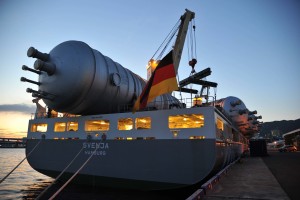
Six vessels will reflag within 2017170925 German Flag - MV Svenja_2

Hamburg, 25 September 2017 – SAL Heavy Lift GmbH, one of the leading heavy lift carriers worldwide, returning to the German Flag.

SAL Heavy Lift is proud to announce that six of its vessels will shortly be flying the German flag. Starting with MV SVENJA on Sept 22nd, MV TRINA, MV ANNE-SOFIE, MV REGINE, MV MARIA and MV WIEBKE will quickly follow. With the home port of Hamburg, the city in which SAL Heavy Lift is also established, the company is build-ing on its German heritage and setting its course for the future.

“We are very proud to return to the German Flag,” says Sebastian Westphal, Corpo-rate Director Ship Management at SAL. “The German flag stands for quality, safety and compliance, and these are core values in SAL, so the German Flag and our cor-porate objectives goes well in hand.”

“It was a logical consequence: a German family owned business with German built vessels, operated by many German officers, and now provided by all the advantages of a German Flag,” Toshio Yamazaki, CEO of SAL Heavy Lift states. “We are proud to put a “made in Germany” tag to what we do – and now sailing the German Flag underlines our commitment to quality and safety.”

By choosing the German flag SAL Heavy Lift also contributes to maintaining the Ger-man maritime cluster with its unique shipping know-how. Training on board vessels flyingthe German flag is ranked top-class internationally. In the long term, top level maritime training in Germany can only be sustained with seafarers employed under the German flag.

Working together with the German Social Accident Insurance Institution for Commer-cial Transport, Postal Logistics and Telecommunication (BG Verkehr) and DNV GL as classification society, the re-flagging process will be handled by leading special-ists.

The decision to re-flag follows careful considerations on the fleet management pro-cess in SAL. Sebastian Westphal comments: “In view of the many benefits of the German Flag, we decided to initiate the re-flagging process. We are happy with the good cooperation we have had with BG Verkehr and DNV GL on the matter, and I know our crew onboard is proud to hoist the German flag.”

About SAL Heavy Lift

SAL Heavy Lift, a member of the Harren & Partner Group, is one of the world’s leading carriers specialized in sea transport of heavy lift and project cargo. The company was founded in 1980 as “Schiffahrtskontor Altes Land GmbH & Co. KG” and belongs to Har-ren & Partner Group since 2017. The modern fleet of 21 heavy lift vessels offers highly flexible options to customers. The vessels of SAL Heavy Lift boast an impressive travel speed of 20 knots, up to 3500 square metres of unobstructed main deck space and com-bined crane capacities ranging from 550 to 2000 tons: amongst the world’s highest lifting capacity in the heavy lift sector. As a leading global company in the heavy lift and project cargo segment, the company meets the highest standards with regard to quality, tech-nical innovation and health, safety and environment.

www.sal-heavylift.com

Press Contact:

SAL Heavy Lift GmbH

Christian Hoffmann

Brooktorkai 20

20457 Hamburg

Phone: +49 40 380 380-235

Email: communications@sal-heavylift.com


GEODIS intern program promotes innovation

SEPTEMBER 21, 2017

POUGHKEEPSIE, NY

Launched by the Poughkeepsie (NY) office, the global internship program during summer 2017 was aimed at promoting continuous innovation. By launching this project, the leadership team of GEODIS fostered innovative ideas for the company while giving the opportunity for local interns to collaborate with their colleagues around the world.

During the summer, a team of six interns in Poughkeepsie hosted video conferences with similar teams in Guadalajara (Mexico), Endicott (NY) and Berlin (Germany). Each team worked on an innovative project to be considered for implementation at the conclusion of the internship program.

Kick-off for this think tank type “innovation lab” in Poughkeepsie took place earlier in spring 2017, via a video conference with a GEODIS team in Guadalajara (Mexico) and Luca Silipo, Chief Economist who runs GEODIS’ World Lab based in Berlin. Preliminary discussions on industry trends and current innovations being developed with GEODIS took place.

The Poughkeepsie team completed mini projects throughout the summer based on professional development, business excellence and corporate values. The interns, along with members of the leadership team, also had visited a ‘fabrication lab’ to develop their practical management skills.

“This summer’s think tank demonstrated a real commitment to innovation and disruption, not only did it give the interns an opportunity to share their perspective and experiences but it also instigated a change in our culture – where we embrace new ideas and assess the future of supply chain” said Eric St. Amand, Vice President, Americas for the Supply Chain Optimization Line of Business.

GEODIS – www.geodis.com

GEODIS is a Supply Chain Operator ranking among the top companies in the field in Europe and the World.  GEODIS, owned by SNCF Logistics, which in turn is a business line of the SNCF Group, is ranked as the number four logistics provider in Europe and number seven at a worldwide level. GEODIS is also listed as a “Leader” in Gartner’s 2016 Magic Quadrant of Worldwide 3PLs. GEODIS’ reach includes a direct presence in 67 countries and a global network spanning over 120 countries. With its five Lines of Business (Supply Chain Optimization, Freight Forwarding, Contract Logistics, Distribution & Express, and Road Transport), GEODIS manages its customers’ Supply Chain by providing end to end solutions enabled by over 39,500 employees, its infrastructure, its processes and systems. In 2016, GEODIS recorded €8 billion in sales.


Publication of the “K” LINE REPORT 2017

Kawasaki Kisen Kaisha, Ltd. (“K” Line) is pleased to announce publication of “K” LINE REPORT 2017

The purpose of the report is to provide all “K” Line stakeholders with a better understanding of the Group’s basic policies and activities for improving our corporate values as well as providing both financial and non-financial information.

This report is composed of the following contents.

“K” LINE Group Value Creation  

We describe “Value Creation Model” which leverages our strength while explaining our group’s philosophy, vision, and history.  “Message from the President” provides our quest to improve corporate value.


Value Creation Initiatives  

We explain overview of both financial and non-financial information and outline of each business as a basis for Value Creation.


Foundation of Value Creation We explain ESG Initiatives which we have positioned as one of the priorities under our new medium-term management plan. In “Chairman and Outside Board Members Roundtable Discussion,”  honest impressions of “K” LINE and role of Outside Board Members are presented.


The “K” LINE REPORT 2017 is available on “K” Line’s website at http://www.kline.co.jp/en/ir/library/annual/index.html or http://www.kline.co.jp/en/csr/report/index.html

Guidance for Carrying Cargo in Non-operating Refrigerated Containers Issued

Two leading container industry bodies, the Container Owners Association (COA) and the Cargo Incident Notification System (CINS), supported by the leading freight transport insurer, TT Club have published an in-depth guide for those seeking to use refrigerated containers in non-operating mode to carry commodities not requiring temperature control.  The Guidelines give extensive advice on the risks involved and correct packing to protect both container and cargo.

London 12 September 2017

The use of ‘non-operating reefers’ (NOR) is common practice in the industry and has significant impact in reducing empty re-positioning costs for container operators.  However both COA and CINS are keen that all involved, including shippers, forwarders, packers and terminals are fully appraised of best practices in the use of such containers.  TT Club, in maintaining its commitment to minimising damage and loss in freight transport, is pleased to have contributed to this valuable guidance.

This new document entitled “Guidelines for the Carriage of Cargoes in Non-Operating Reefer Containers” outlines in detail the caution that must be employed in using NORs considering the difference in design between a reefer container and a regular General Purpose (GP) unit, noting specifically the internal dimensions, vulnerable insulation, weight distribution and expensive refrigeration machinery. Types of NOR cargo need to be approved and recommendations are given as to which should not be carried either because of risk of contamination or the inability to secure them sufficiently.

“Repositioning expensive reefer units after they have been emptied at destination is a constant challenge for container operators”, explains Uffe Ernst-Frederiksen – Maersk Line’s Head of Cargo Management, as well as Chairman of CINS and Deputy Chairman of the COA. “There is often insufficient temperature controlled cargo for the return leg of a reefer’s journey and therefore the unit has to be repositioned empty. On busy trade lanes, empty reefers are competing for slot space with revenue earning dry cargo, so the NOR solution is attractive.  However, care must be taken when loading NOR cargo, to avoid disproportionate costs being incurred in cargo loss and container damage.”

“These guidelines will be extremely useful in helping operators, shippers and those responsible for packing NORs make decisions that will project both cargo and reefer unit from such loss and damage,” comments TT Club’s Risk Management Director, Peregrine Storrs-Fox.  “TT Club is therefore very pleased to have worked with COA and CINS in producing this valuable document.”

A PDF of the Guidelines is now available to download – click here

ENDS

Notes for Editors:

The Container Owners Association (COA) is an international organisation representing the common interests of all owners of freight containers.  Full members comprise container shipping lines and container leasing companies, while associate members include suppliers of container equipment and services.

The principle aims of the COA are as follows:

  • Development of Industry Standards – with the aim of promoting industry efficiency
  • Dissemination of information through Conferences, Training and Education
  • Lobbying relevant regulatory authorities and co-operation with industry groups
  • Promotion of Safe Operation of Containers
  • Promoting Environmental Awareness

www.containerownersassociation.org

TT Club is the international transport and logistics industry’s leading provider of insurance and related risk management services. Established in 1968, the Club’s membership comprises ship operators, ports and terminals, road, rail and airfreight operators, logistics companies and container lessors. As a mutual insurer, the Club exists to provide its policyholders with benefits, which include specialist underwriting expertise, a world-wide office network providing claims management services, and first class risk management and loss prevention advice. TT Club is managed by Thomas Miller.

www.ttclub.com

Cargo Incident Notification System (CINS) is a shipping line initiative, launched in September 2011, to increase safety in the supply chain, reduce the number of cargo incidents on-board ships and on land, and highlight the risks caused by certain cargoes and/or packing failures. Membership of CINS comprises over 65 percent of the world’s container slot capacity. The CINS database permits analysis of operational information on cargo and container incidents which lead to injury or loss of life, loss or serious damage of assets, or environmental concerns. The database includes root cause analysis.

CINS publishes Operational Guidelines on the carriage of certain cargoes in containers.

www.cinsnet.com


“K” Line Continues to be Selected as an Index Component Participant of the Dow Jones Sustainability Asia Pacific Index

Kawasaki Kisen Kaisha, Ltd. (“K” Line) has been selected again as an Asia Pacific Index component company of the Dow Jones Sustainability Indices (DJSI), one of the leading global indices on Socially Responsible Investment (SRI)(*1). It has been “K” Line’s good fortune to have been selected for 7 consecutive years since 2011.

DJSI is the world’s leading SRI Index jointly operated by S&P Dow Jones Indices LLC of the United States and Robeco SAM AG of Switzerland, which only includes the top-ranked companies among all large worldwide companies as a result of its evaluation of their sustainability performance in terms of social, environmental and economic criteria. Launched in 1999, DSJI is one of the first global sustainability benchmarks for investors which integrate sustainability consideration into their portfolios.

“K” Line group always strives to contribute to the realization of an even better society as well as continuously increasing its corporate value.

*1 SRI (Socially Responsible Investment) describes an investment strategy which takes account of enterprises’ social, ethical and environmental aspects as well as financial performance.

“K” Line Group Collaborating for Japan’s First LNG-fueled Ferry

Kawasaki Kinkai Kisen Kaisha, Ltd. (“K” Line Kinkai) and Kawasaki Kisen Kaisha, Ltd. (“K” Line) have agreed to work on joint study for “K” Line Kinkai’s newbuilding passenger ferry being fueled by LNG, whose study includes specifications, engine types and any related technical verifications for LNG handling.

“K” Line Kinkai has been studying introduction of a ferry fueled by LNG, an environmentally-friendly energy that could almost completely eliminates SOx emissions and also minimizes NOx and CO2 emissions to certain level, and the recent collaboration with “K” Line will accelerate this study in order to introduce Japan’s first passenger LNG-fueled ferry. “K” Line Group has also been studying introduction of various types of LNG-fueled vessels, including car carrier and tugboat as well as LNG supply business.

“K” Line Group is promoting environmental measures based on “K” LINE Environmental Vision 2050 (Note 1) that is the Group’s long-term environment management vision toward 2050. Having more than 40 years of experience in operation and management of liquefied gas carriers, we will continue to aim with collective effort of “K” Line Group for the realization of being a business that enables a greater number of people around the world to enjoy the advantage of marine transportation characterized by a lower environmental load and higher efficiency by means of marine fuels such as LNG and LPG that are more environmentally friendly.

Note 1

“K” LINE Environmental Vision 2050 – Navigating for Sustainability Leading to a Brighter Future:

Please refer to this link :  http://www.kline.co.jp/en/news/detail/1202375_1997.html

New “K” Line LNG Carrier for Ichthys LNG Project Named “PACIFIC BREEZE”

170901 Pacific Breeze Naming Ceremony

Naming Ceremony for “PACIFIC BREEZE”

Kawasaki Kisen Kaisha, Ltd. (“K” Line) held naming ceremony for the newly-built liquefied natural gas (LNG) carrier at Sakaide Shipyard of Kawasaki Heavy Industries, Ltd. (KHI).

The new vessel was given her name “PACIFIC BREEZE” by Mr. Jeng-Zen Fang, Vice President of CPC Corporation, Taiwan (CPC).

Designed by KHI, PACIFIC BREEZE is the largest Moss-type LNG carrier. She is also the first Moss-type LNG carrier equipped with the Tri-Fuel Diesel (TFD) Propulsion System which accomplishes low fuel consumption together with bringing environmentally friendly conditions.

“PACIFIC BREEZE” will be time-chartered by IT Marine Transport Pte. Ltd., a joint-venture company between INPEX Corporation and TOTAL S.A., and consigned to CPC and will be carrying LNG from the Ichthys LNG Project in Darwin, Australia to Taiwan after her delivery.


Main Particulars of the vessel

Owner Pacific Breeze LNG Transport S.A.
Charter IT Marine Transport Pte. Ltd.
Shipyard Kawasaki Heavy Industries, Ltd. (Sakaide Shipyard)
LOA abt. 289.3m
Beam abt. 52.0m
Tank Type / Tank Capacity Moss / abt.182,000m3
Propulsion System TFD (Tri-Fuel Diesel)


KL Sandefjord – First Offshore Vessel with DNV GL’s “Shore Power” Class Notation

170831 KL Sandlefjord

Kawasaki Kisen Kaisha, Ltd – August 31, 2017

The offshore vessel “KL Sandefjord” owned by K Line Offshore AS being a 100% subsidiary of Kawasaki Kisen Kaisha, Ltd (“K” Line), is the first offshore vessel with the DNV GL class notation “Shore power”. The “Shore power” notation, verifies the design and installation of a vessel’s on-board electrical shore connection. When in port, the vessel can shut down its engines and rely on a shore based electrical supply for its needs at berth – so called “cold ironing”.

“We are very pleased to receive this notation for our large and powerful anchor handler KL Sandefjord, which reflects our commitment to ensure a cleaner port environment and a more pleasant shipboard for our crew when berthing,” says Espen Sørensen, Senior Vice President, Operation and Technical in K Line Offshore AS. “With an on-board shore power installation tested and verified by DNV GL, we now have an offshore vessel equipped for the future. And as result of the good cooperation we have enjoyed with the Bergen Port Authority and DNV GL during this process, we have also decided to apply for the Shore power class notation for the sister vessel, KL Saltfjord.”

By tapping into an onshore electrical supply, vessels not only reduce their fuel consumption, but they also eliminate the associated emissions. This will have a marked improvement on the air quality in the port and surrounding environment, cutting PPM, NOx, SOx and reducing CO2, through the use of more efficient shore based electricity. In combination with renewable energy sources, it can even result in zero emission operation for the duration of a vessel’s stay in port. On top of which it can free the engines for maintenance, and reduces wear and tear, and noise.

“There is an increasing awareness of the impact of shipping emissions in ports and this is driving investments in cold ironing,” says Jon Rysst, Senior Vice President and Regional Manager North Europe, DNV GL. “This is leading to ports both requiring and incentivizing the use of alternative marine power. In Norway, where KL Sandefjord operates, for example, many ports are also offering a discount for ships with shore power installation. As access expands, alongside the rise of fully electric and hybrid vessels, cold ironing could soon become standard procedure in many ports around the world – with a noticeable positive impact on air quality.”

The DNV GL electrical shore connection class rules cover safety requirements for a vessel’s on-board electrical shore connection. The Shore power notation ensures a safe and efficient way of performing the connection and disconnection of shore power by verifying and checking the total system of the electrical shore connection, verifying compatibility between ship and port and provide recommendations for a well-defined future proof technical solution.

Safety in the Intermodal Supply Chain: Promoting the CTU Code

16 August, 2017

London International Shipping Week takes place between 11th and 15th September, during which an event at the IMO will focus on the correct packing of Cargo Transport Units (CTUs) and the safety issues that result from poor packing and securing practices. ‘Safety in the Intermodal Supply Chain’ will promote the awareness, understanding and implementation of the IMO/ILO/UNECE Code of Practice for Packing of Cargo Transport Units (CTU Code)[1]. The event will take place on Tuesday 12 September at 17:30 in the IMO Building, London and will be followed by a networking reception.

The hosts are the same alliance of industry organisations that are committed to promoting safety in the CTU supply chain and successfully supported global compliance efforts in relation to the verified gross mass (VGM) requirements for packed containers. This alliance, Global Shippers Forum (GSF), ICHCA International, TT Club and World Shipping Council (WSC), launched its campaign to address the dangers posed by incorrectly packed and secured cargo in all types of cargo transport units at the European Shipping Week in Brussels in February and is pleased to have the support once more of the IMO.

Held at the IMO during the fourth meeting of its Sub-Committee on Carriage of Cargoes and Containers (CCC 4), this event will be followed by a networking reception, during which the winner of the 2017 BIC Award[2] will be announced. Each year the BIC Award honours an organisation or individual for a significant contribution to the advancement of safety, security or sustainability in container transportation.

Speakers from the four host organisations will present during the event and facilitate discussion on key current topics in which the delegates attending will be encouraged to participate.  Lars Kjaer of the WSC explains, “The event will include a presentation of the current status of our campaign and an opportunity to debate how knowledge and application of the Code can be promoted.”

In highlighting the key timing of the event, Peregrine Storrs-Fox from TT Club states, “The occasion provides a unique opportunity for senior shipping executives to engage with key safety messages and network with the representatives of national governments from around the globe who determine the development and implementation of maritime regulation – all in the setting of the only UN agency based in London.”

“It is now almost three years since the three UN bodies that sponsored the CTU Code approved its content,” comments ICHCA’s Captain Richard Brough OBE. “While a non-mandatory Code of Practice, it is now thoroughly referenced in the IMDG Code.  The entire freight industry must recognise that this detailed guidance may now be seen as representing industry best practice.”

The importance of awareness across the entire supply chain of these dangers is a point emphasised by Chris Welsh MBE of the GSF, “The responsibilities of all those working in the supply chain, shippers, packers, forwarders, warehouse operators and transport providers for all modes and in all countries are clearly set out in the Code. The fundamental responsibilities for the safety of cargo packing and those handling CTUs are determined at the outset, but do not cease when the doors of the trailer or container are closed”, he concludes.

Register your attendance here

ENDS

Notes for Editors

The Global Shippers’ Forum (GSF) is the world’s leading global trade association representing shippers engaged in international trade moving goods by all modes of transport. Chris Welsh MBE chaired the Expert Working Group charged with drafting IMO/ILO/UNECE Code of Practice for Packing of Cargo Transport Units (CTU Code). More information is available at: www.globalshippersforum.com

The International Cargo Handling Coordination Association (ICHCA) is an independent, not-for-profit organization dedicated to improving the safety, security, sustainability, productivity and efficiency of cargo handling and goods movement by all modes and through all phases of national and international supply chains. ICHCA actively participated in the Expert Working Group and debates leading to the approval of the CTU Code. More information is available at:  http://ichca.com

The TT Club is the international transport and logistics industry’s leading provider of insurance and related risk management services. The TT Club participated in the Expert Working Group and debates leading to the approval of the CTU Code. More information is available at: www.ttclub.com.

The World Shipping Council (WSC) represents the global liner shipping industry on regulatory, environmental, safety and security policy issues.  The WSC has observer status at the IMO and was actively involved in the development of the CTU Code. More information is available at: www.worldshipping.org.

##

[1] http://www.imo.org/en/OurWork/Safety/Cargoes/CargoSecuring/Pages/CTU-Code.aspx

[2] www.bic-code.org/about-us/bic-awards